
Embracing Consistency in an Inconsistent World: Why Routines Matter, Especially for Children with Autism
Life is full of unpredictability. At every turn, we are met with change—shifting seasons, unpredictable weather, and a whole host of variables that are beyond our control each day. This persistent inconsistency is simply part of being alive, part of our daily navigation through the world. For many, variety is stimulating and even exciting. But for others, especially children with autism, the constant uncertainty of everyday life can be overwhelming and anxiety-provoking.
While embracing some change is part of personal growth and flexibility, for children with autism, incorporating consistent routines can provide crucial support. This article explores the importance of consistency against the backdrop of life’s natural variety, focusing on practical strategies and real-life experiences from the Accessible Hope center.
Why Inconsistency Can Be Challenging
Every day brings new variables—for everyone. The weather changes, plans shift unexpectedly, noises and environments are different, and social interactions are full of surprises. For neurotypical children, these constant changes may be little more than background noise. But for children on the autism spectrum, inconsistency can be stressful to manage. Each new variable requires extra mental energy to process, adapt, and respond.
Children with autism are often more sensitive to sensory information and changes in routine. When so much in life feels unpredictable, anxiety can increase. The unfamiliar can feel overwhelming, and the lack of structure can make it difficult to know what to expect or how to act. This is where intentional consistency becomes not just helpful, but essential.
The Role of Predictable Routines
At Accessible Hope, a center dedicated to supporting children with autism, staff members have witnessed first-hand the benefits of repeatable routines. Predictable sequences in the daily schedule help reduce anxiety and foster a sense of safety.
Some key elements practiced at the center include:
- Daily Dance Ritual: After morning circle time, staff and children do the same dance each day. It's completely acceptable—and even encouraged—to continue with the same dance for a whole month. Changing it too frequently can actually disrupt the sense of comfort; changing it after a month or so helps avoid rigidity but maintains overall predictability.
- Familiar Opening and Closing Songs: Circle time always opens with the same song, "Rise and Shine" by Dr. Jean, and every day ends with a familiar goodbye song. These musical bookends provide clear signals and a comforting sense of rhythm, giving children an immediate sense of what to expect.
- Repetitive Play and Games: It’s okay to play the same game daily during a designated game time. While variety has its place, consistent game choices minimize unpredictability and allow children to engage more comfortably—reducing anxiety around new or unfamiliar activities.
- Consistent Meals: Even outside the classroom, predictability plays a role. For example, one family shared their routine of eating the same breakfast together each morning: oatmeal with a little Ceylon cinnamon, a pinch of salt, and crunchy, natural peanut butter. Occasionally, they'll swap it for Cheerios and milk, but 95% of the time, breakfast is the same, minimizing the need for daily decision-making.
The Benefits of Consistency
Implementing routine and predictability in a child’s day does not mean eliminating all variety. Rather, it means providing enough stability so the unpredictable aspects of life are less overwhelming. The goal is to strike a balance: create consistent, predictable frameworks for the day, and then let the unavoidably unexpected flow within those boundaries.
Key benefits of consistency for children with autism include:
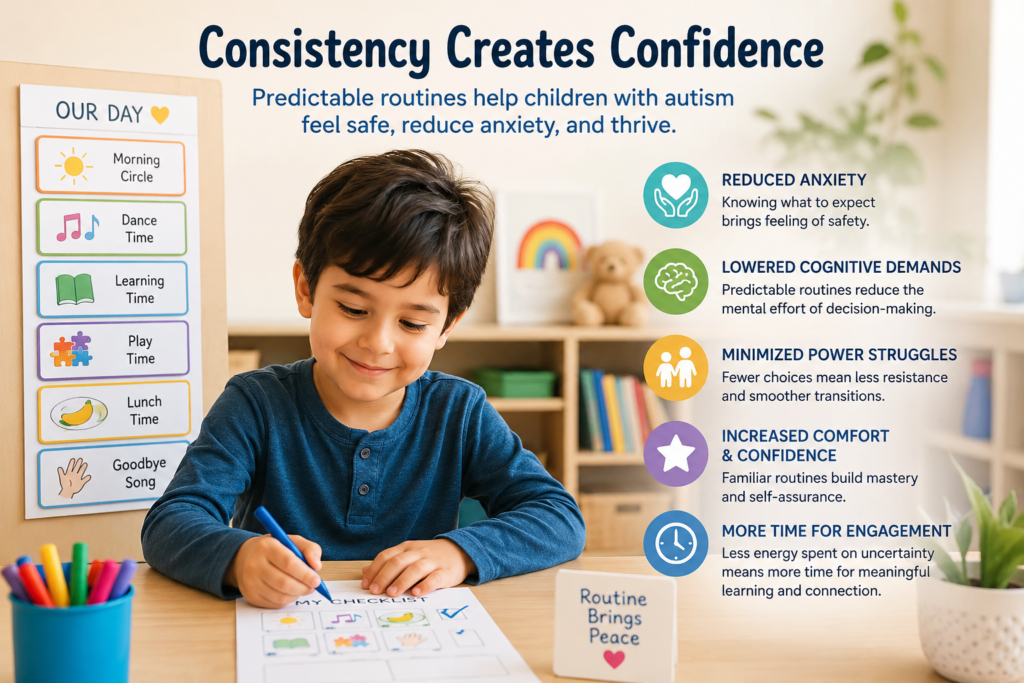
- Reduced Anxiety: When a child knows what to expect, uncertainty—and the anxiety it causes—decreases significantly.
- Lowered Cognitive Demands: Predictable routines reduce the mental effort required to process instructions, plan, and make decisions.
- Minimized Power Struggles: Fewer choices mean fewer negotiations. Children are less likely to resist routines that are already familiar.
- Increased Comfort and Confidence: Familiar routines are practiced until children feel comfortable and capable, which enhances their confidence.
- More Time for Engagement: When less time is spent navigating uncertainty, more time can be spent truly engaging in meaningful, enjoyable activities.
Avoiding Rigidity
There’s a common concern that consistent routines will encourage rigidity. At Accessible Hope, this is addressed by introducing change at reasonable intervals, rather than daily. The key is not to change things constantly, but instead to offer stability—and then make careful, purposeful adjustments when needed. If the same dance is done every morning for a month, and then a new one is introduced, this transition gently encourages flexibility while keeping life’s unpredictability manageable.
Eventually, all children will become bored with monotonous repetitions, but for many on the autism spectrum, it takes significantly longer for boredom to set in than for them to master a routine. By the time a child is truly ready for a change, they are also more prepared to handle it.
Practical Applications for Families and Caregivers
Routines need not be elaborate or artificial. In fact, the best routines are easy to maintain:
- Use the same opening or transition song for common activities.
- Establish predictable mealtime routines; even simple ones, like having the same breakfast, ease morning stress.
- Give children consistent responsibilities or roles, so they know their place and what is expected.
- Change routines only when necessary, and when you do, prepare the child with advance notice and clear explanations.
Conclusion
The world is a shifting landscape of change and unpredictability. For children with autism, these endless variables can make daily living unnecessarily challenging. By intentionally creating areas of consistency, caregivers, educators, and families can offer children a stable footing. Rather than eliminating all change—which is impossible—thoughtful routines create a framework wherein children can grow, learn, and thrive with less anxiety and more confidence. Embracing some sameness amid the world’s variety is not limiting for children with autism: it's liberating.